
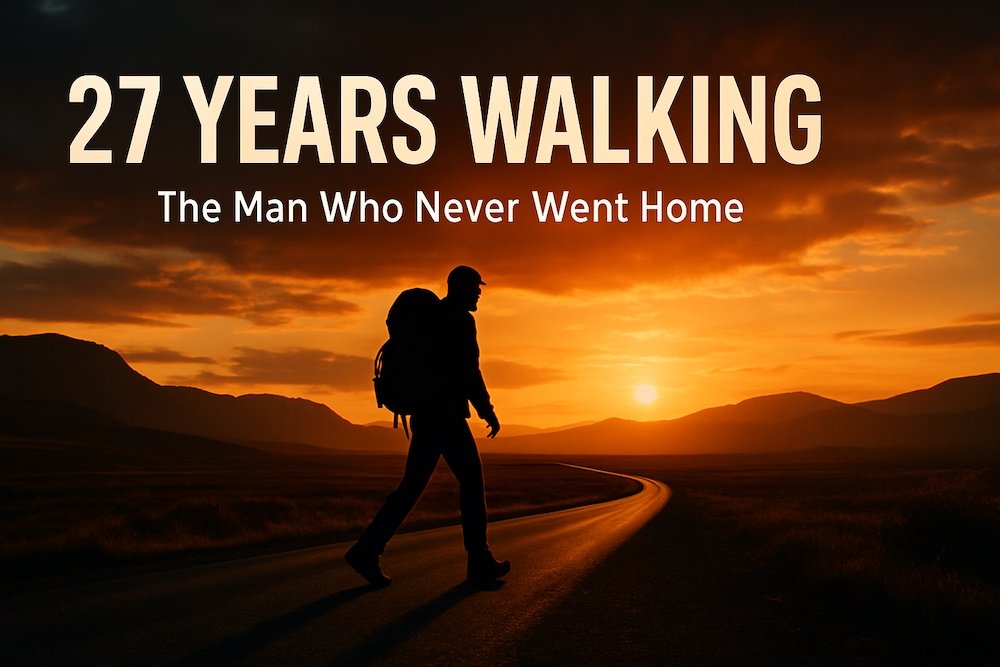
Introduction: The Man Who Refuses to Stop Walking
Karl Bushby represents the ultimate expression of human determination and endurance. Since 1998, this former British paratrooper has been walking around the world with one simple rule: no motorized transport until he returns home to Hull, England. Moreover, his journey spans nearly three decades of continuous travel across every continent.
The Goliath Expedition, as his trek is known, has covered over 47,000 kilometers through some of the world’s most challenging terrain. Additionally, Bushby has survived wars, pandemics, arrests, and bureaucratic nightmares while maintaining his unwavering commitment to completing the journey on foot. Furthermore, with just 3,000 kilometers remaining, the world’s longest walk approaches its historic conclusion in 2026.
The Genesis of an Impossible Dream
A Paratrooper’s Vision
Karl Bushby was born on March 30, 1969, in Hull, England, and served as a British paratrooper before embarking on his extraordinary journey. His military background provided the physical and mental foundation necessary for such an ambitious undertaking. Moreover, the discipline and resilience developed during his service proved crucial for surviving the challenges ahead.
On November 1, 1998, Bushby began his walk from Punta Arenas, Chile, with a vision that seemed impossible to most observers. Additionally, he established strict rules that would govern his entire journey: no motorized transport, no flying home for visits, and no deviation from the walking route. Furthermore, these self-imposed limitations would define every decision throughout the next 27 years.
The Route That Defied Logic
The planned route required crossing multiple continents, political borders, and geographical obstacles that had never been attempted on foot. The journey would take him through South America, Central America, North America, across the Bering Strait, through Siberia, Central Asia, the Middle East, and finally into Europe. Moreover, each section presented unique challenges that would test human endurance limits.
The route planning required careful consideration of climate patterns, political stability, and visa requirements across dozens of countries. Additionally, Bushby had to account for seasonal changes that could make certain passages impossible during specific times of year. Furthermore, geopolitical events would frequently force route modifications and create years-long delays.
Epic Challenges That Define Human Limits
Crossing the Bering Strait on Foot
In March 2006, Bushby achieved what many considered impossible: crossing the Bering Strait on foot. Accompanied by French adventurer Dimitri Kieffer, he traversed the frozen waters between Alaska and Russia during the brief window when ice conditions allowed passage. Moreover, this crossing represented one of the most dangerous achievements in modern exploration.
The crossing required navigating shifting ice floes, open water leads, and extreme temperatures that could prove fatal within minutes. Additionally, both men faced the constant threat of ice breaking apart beneath their feet, potentially separating them from safety forever. Furthermore, the achievement demonstrated that human determination could overcome seemingly impossible geographical barriers.
The Bering Strait crossing gained international attention and established Bushby as a serious adventurer rather than an eccentric dreamer. Moreover, it proved that his ambitious walking route was technically feasible, even if extraordinarily challenging. Additionally, the crossing required months of preparation and perfect timing with weather conditions.
Swimming the Caspian Sea: 288 Kilometers of Pure Determination
When traditional border crossings proved impossible, Bushby made a decision that redefined extreme endurance: swimming across the Caspian Sea. In August 2024, blocked from entering Russia or Iran by land, he swam approximately 288 kilometers from Kazakhstan to Azerbaijan over 31 days. Moreover, this aquatic detour demonstrated his unwavering commitment to continuing the journey without motorized transport.
The Caspian Sea crossing involved swimming in two daily three-hour sessions while resting on support boats between efforts. Additionally, the physical and mental demands of maintaining this schedule for over a month pushed human endurance to its absolute limits. Furthermore, the crossing required careful coordination with weather conditions and maritime authorities.
This achievement highlighted Bushby’s adaptability when faced with insurmountable bureaucratic obstacles. Moreover, it demonstrated that his commitment to the walking rules extended to finding creative solutions that maintained the journey’s integrity. Additionally, the swimming crossing gained significant media attention and renewed interest in his overall expedition.
Surviving Wars, Pandemics, and Political Upheaval
Throughout his 27-year journey, Bushby has navigated numerous global crises that would have ended most expeditions. He has walked through regions experiencing armed conflicts, survived the COVID-19 pandemic while camping in remote areas, and adapted to constantly changing political landscapes. Moreover, each crisis required innovative solutions to continue the journey safely.
During the pandemic, Bushby faced unique challenges as borders closed and support networks disappeared. Additionally, he had to maintain social distancing while relying on local communities for basic supplies and shelter. Furthermore, the pandemic created years-long delays as visa processing stopped and international travel restrictions prevented progress.
Political upheavals in various countries forced route changes and created lengthy bureaucratic delays. Moreover, Bushby has been arrested, detained, and had equipment confiscated by authorities who couldn’t understand his mission. Additionally, these experiences demonstrate the intersection between personal determination and global political realities.
The Physical and Mental Toll of 27 Years
Daily Routine and Physical Demands
Bushby maintains a disciplined daily routine that has remained largely consistent throughout the 27-year journey. He typically walks seven to eight hours per day, covering an average of 32 kilometers when conditions permit. Moreover, his pace allows for rest, equipment maintenance, and interaction with local communities along the route.
The physical demands of continuous long-distance walking have required careful attention to nutrition, equipment, and injury prevention. Additionally, Bushby has developed expertise in wilderness survival, basic medical care, and equipment repair through necessity. Furthermore, his military background provided crucial training for maintaining physical and mental resilience under extreme conditions.
His equipment includes a specially designed cart nicknamed “The Beast,” which carries essential supplies including shelter, food, water purification equipment, and communication devices. Moreover, the cart’s design has evolved throughout the journey based on practical experience and changing requirements. Additionally, maintaining and protecting this equipment has been crucial for survival in remote areas.
Psychological Resilience and Motivation
The psychological challenges of a 27-year journey cannot be understated. Bushby has spent more time walking than many people spend in their entire careers, often alone in challenging environments. Moreover, the mental discipline required to continue despite setbacks, loneliness, and physical discomfort represents extraordinary psychological resilience.
Maintaining motivation during bureaucratic delays that last months or years requires exceptional mental strength. Additionally, Bushby has had to adapt to constantly changing circumstances while maintaining focus on the ultimate goal. Furthermore, the psychological impact of being away from home and family for nearly three decades adds another layer of complexity to his achievement.
The mental aspects of extreme endurance have been as challenging as the physical demands. Moreover, Bushby has developed coping strategies for dealing with isolation, uncertainty, and the pressure of international attention. Additionally, his ability to find meaning and purpose in daily progress toward a distant goal demonstrates remarkable psychological endurance.
Bureaucratic Nightmares and Visa Challenges
The Current Predicament: Stuck in Mexico
As of January 2025, Bushby faces one of his most frustrating obstacles: waiting in Mexico for a Turkish visa renewal. After successfully entering Europe via Istanbul’s Bosphorus Bridge on May 2, 2025, Daily Sabah reported that he had covered nearly 50,000 kilometers on foot before reaching this crucial milestone. Moreover, The Hull Story provided exclusive coverage of his Bosphorus crossing, emphasizing the significance of this “big moment” in his epic journey from South America to Europe.
The irony of being physically capable of completing the journey but legally prevented from doing so highlights the modern challenges of extreme adventure travel. Additionally, visa requirements that didn’t exist when he started his journey in 1998 have created new obstacles that test his patience and determination. Furthermore, the situation demonstrates how bureaucratic systems struggle to accommodate unprecedented individual achievements.
This delay represents months of lost progress when Bushby is within 3,000 kilometers of his ultimate destination. Moreover, it exemplifies the countless bureaucratic challenges he has faced throughout the journey that have extended the timeline far beyond original estimates. Additionally, each delay tests his resolve to maintain the strict rules he established at the journey’s beginning.
A History of Visa Complications
Visa issues have been a recurring theme throughout Bushby’s journey, creating delays that have added years to the overall timeline. Previous complications in Turkmenistan, Russia, Iran, and other countries have forced extended stops and route modifications. Moreover, changing political relationships between countries have made some borders impossible to cross legally.
The post-9/11 world has created additional security concerns that complicate border crossings for unusual travelers like Bushby. Additionally, his unique travel pattern and extended time in certain regions have raised suspicions among immigration authorities. Furthermore, the lack of precedent for his type of journey means officials often don’t know how to process his visa applications.
These bureaucratic challenges highlight the intersection between individual adventure and institutional systems designed for conventional travel. Moreover, Bushby’s experience demonstrates how global security concerns and immigration policies can impact even benign individual achievements. Additionally, each visa denial or delay requires creative problem-solving to maintain journey integrity.
Cultural Encounters and Human Connection
Communities Along the Route
Throughout his 27-year journey, Bushby has encountered thousands of individuals and communities who have provided support, hospitality, and friendship. These human connections have been crucial for practical survival and psychological well-being during the expedition. Moreover, the kindness of strangers has enabled him to continue during the most challenging periods.
Local communities have provided food, shelter, equipment repairs, and guidance through difficult terrain. Additionally, these interactions have given Bushby insights into diverse cultures and ways of life that few travelers experience. Furthermore, his slow pace of travel allows for meaningful connections that rushed tourism cannot provide.
The language barriers and cultural differences encountered along the route have required patience and adaptability. Moreover, Bushby has learned basic communication skills in multiple languages out of necessity. Additionally, his respectful approach to different cultures has generally resulted in positive reception from local communities.
Technology Evolution During the Journey
The technological landscape has transformed dramatically during Bushby’s 27-year journey, creating both opportunities and challenges. When he started in 1998, GPS devices were expensive and unreliable, social media didn’t exist, and international communication was difficult and expensive. Moreover, he has witnessed and adapted to the digital revolution while maintaining his analog approach to travel.
Modern smartphones, satellite communication devices, and GPS navigation have made certain aspects of the journey easier and safer. Additionally, social media platforms allow him to share updates with supporters worldwide and maintain connections despite physical isolation. Furthermore, improved weather forecasting and emergency communication capabilities have reduced some risks.
However, the digital divide in remote areas means he still relies heavily on traditional navigation and survival skills. Moreover, equipment reliability in extreme conditions remains a constant concern regardless of technological advances. Additionally, the contrast between his 1998 starting point and today’s connected world highlights the remarkable duration of his journey.
The Final Stretch: 3,000 Kilometers to History
Route Through Europe
Once visa issues are resolved, Bushby’s planned European route will take him through Turkey, Bulgaria, Serbia, Hungary, Austria, Germany, and France before reaching the English Channel. ExplorersWeb’s detailed analysis of his home stretch reveals that each country presents its own bureaucratic requirements, but the distances are manageable compared to earlier continental crossings. Moreover, Türkiye Today reports that after surviving dangerous stages like the Darien Gap, Bering Strait crossing, and Caspian Sea swim, the European infrastructure will provide more predictable conditions for the final phase.
The European leg represents a psychological milestone as Bushby enters familiar territory with languages and cultures closer to his British origins. Additionally, media attention and public support are likely to increase as he approaches his home country. Furthermore, the relatively short distances between major cities will allow for more frequent resupply and support opportunities.
Weather conditions in Europe present different challenges than the extreme climates he has previously encountered. Moreover, the seasonal timing of his passage will be crucial for maintaining progress through potential winter conditions. Additionally, the urban nature of much of the European route will require different navigation and logistics strategies.
The Channel Tunnel Challenge
The final major obstacle involves crossing from France to England, which presents unique technical challenges. Bushby plans to use a maintenance shaft in the Channel Tunnel, but this requires special permissions from authorities who must balance safety concerns with recognition of his historic achievement. Moreover, the crossing represents the culmination of nearly three decades of continuous effort.
Traditional ferry crossings would violate his no-motorized-transport rule, making the tunnel the only viable option for maintaining journey integrity. Additionally, the engineering and safety requirements of the tunnel create bureaucratic complexities that could delay the completion. Furthermore, coordination with multiple authorities and organizations will be required to facilitate this unprecedented crossing.
The symbolic importance of this final crossing cannot be overstated, as it represents the completion of humanity’s longest continuous walk. Moreover, the technical challenges of arranging tunnel access demonstrate how modern infrastructure can complicate even the most determined individual efforts. Additionally, the crossing will require careful documentation to verify the achievement’s legitimacy.
Creating Viral Content About Human Endurance
Video Production and Storytelling
Bushby’s story provides exceptional material for AI video creation platforms due to its incredible scope and emotional impact. The visual contrast between his 1998 starting point and today’s world creates compelling storytelling opportunities, as demonstrated in our viral short video showcasing his incredible 27-year journey. Moreover, the human interest elements appeal to audiences seeking inspiration and motivation, similar to how stories of perseverance resonate across different contexts, from extreme endurance to treasure hunters who spent decades searching before discovering $160 million in gold.
Professional video editing tools like Pictory can enhance documentary content about extreme endurance achievements with engaging visual elements. Additionally, these platforms enable creators to produce educational content that combines adventure storytelling with motivational messaging. Furthermore, the timeline and geographical scope provide rich material for various content formats.
The story’s emotional arc from ambitious beginning through countless obstacles to approaching triumph creates natural narrative tension. Moreover, the real-time aspect of his current progress allows for ongoing content creation and audience engagement. Additionally, the universal themes of perseverance and determination appeal to diverse demographics.
Social Media Strategy and Audience Building
Adventure content performs exceptionally well across social media platforms when it combines authentic human achievement with compelling storytelling. Furthermore, Bushby’s story appeals to audiences interested in adventure, motivation, human endurance, and geographic exploration. The multi-generational timeline means his journey spans the entire social media era, creating natural content opportunities for various platforms.
Email marketing through platforms like Beehiiv can build engaged communities of adventure enthusiasts and endurance athletes. Additionally, regular updates about his progress maintain subscriber interest while providing educational content about geography and cultures. The completion timeline creates natural urgency for audience engagement and community building around extraordinary human achievements.
The inspirational aspects of extreme determination appeal to motivational content audiences seeking examples of human potential. Moreover, the practical elements of long-distance travel and survival skills attract outdoor adventure communities. Additionally, the geographic and cultural diversity of his route provides educational value for geography and travel enthusiasts.
Educational Content Development
Bushby’s journey provides excellent case studies for geography education, cultural studies, and human psychology courses. Moreover, the physical and mental challenges offer insights into human endurance limits and adaptation strategies. Learning platforms can incorporate his achievement into curricula focused on perseverance and goal achievement, while AI avatar creation tools enable engaging educational presentations about extreme endurance and the psychological aspects of long-term goal pursuit.
The intersection of individual determination and global political realities provides valuable lessons for international relations studies. Additionally, his navigation of bureaucratic systems offers insights into modern travel challenges and diplomatic complexities. Furthermore, the cultural encounters throughout his journey provide anthropological perspectives on human diversity and universal hospitality.
Adventure education programs can use his systematic approach to extreme challenges as examples of planning, risk management, and adaptation strategies. Moreover, the psychological aspects of maintaining motivation during extended isolation provide insights into mental resilience training. Additionally, his equipment innovations and survival techniques offer practical lessons for outdoor education.
Digital Security and Communication
Staying Connected in Remote Areas
Modern communication technology has been crucial for Bushby’s safety and coordination throughout remote sections of his journey. Additionally, satellite communication devices enable emergency contact and location tracking when traditional networks are unavailable. VPN services like Surfshark protect his communications and data access in countries with restricted internet access, ensuring secure connectivity even when crossing regions with varying levels of digital infrastructure and internet freedom.
The evolution of communication technology during his 27-year journey has dramatically improved safety and support capabilities. Moreover, real-time location sharing allows support networks to monitor his progress and coordinate assistance when needed. Additionally, weather updates and route planning benefit from improved satellite coverage and data availability.
However, equipment reliability in extreme conditions remains a constant concern regardless of technological advances. Furthermore, power management and equipment protection require careful planning and backup systems. The balance between connectivity and self-reliance reflects broader challenges of modern adventure travel.
Documentation and Verification
Maintaining accurate documentation of his route and achievements has been crucial for verification and historical record-keeping. Additionally, GPS tracking and photographic evidence provide objective proof of his unprecedented accomplishment. Furthermore, witness statements and media coverage create independent verification of key milestones.
The documentation process has evolved with technology, from early paper logs and film cameras to digital tracking and cloud storage. Moreover, the verification requirements demonstrate the importance of credible evidence for record-breaking achievements. Additionally, the historical significance of his journey requires meticulous documentation for future researchers and adventurers.
Modern technology enables real-time verification and audience engagement that wasn’t possible when he started in 1998. Furthermore, social media updates and GPS tracking allow supporters to follow his progress continuously. The transparency enabled by modern communication technology enhances credibility and public engagement with his achievement.
The Psychology of Extreme Endurance
Mental Strategies for Long-term Goals
Bushby’s ability to maintain focus on a 27-year goal while managing daily challenges demonstrates extraordinary psychological endurance. The Armchair Adventure Festival provides personal insights into his motivation and the psychological context behind his extraordinary adventure, revealing the mental strategies he has developed that provide insights into human motivation and resilience under extreme conditions. Moreover, his approach to breaking down an impossible goal into manageable daily tasks offers lessons for achieving any long-term objective, much like how the human brain efficiently manages complex tasks using just 20 watts compared to AI systems requiring billions of watts for similar cognitive processing.
The psychological impact of extended isolation and uncertainty requires specific coping mechanisms that Bushby has refined through experience. Additionally, maintaining motivation during years-long delays tests mental resilience in ways that few other experiences can replicate. Furthermore, his ability to find meaning in daily progress toward a distant goal demonstrates remarkable psychological sophistication.
The intersection of physical and mental endurance in extreme challenges shows how psychological preparation is as important as physical conditioning. Moreover, Bushby’s experience provides a unique case study in human adaptation to prolonged stress and uncertainty. Additionally, his mental resilience offers inspiration for individuals facing their own long-term challenges.
Dealing with Setbacks and Adaptation
The countless setbacks, delays, and route modifications throughout Bushby’s journey demonstrate the importance of psychological flexibility in extreme endeavors. Additionally, his ability to adapt plans while maintaining core objectives shows how persistence requires both determination and adaptability. Furthermore, each major setback has tested his commitment to completing the journey according to his original rules.
Learning to find opportunities within obstacles has been crucial for maintaining forward progress despite bureaucratic delays and political complications. Moreover, Bushby’s experience shows how extreme challenges require both detailed planning and spontaneous problem-solving abilities. Additionally, his psychological adaptation to constantly changing circumstances provides insights into human resilience.
The emotional challenges of being away from family and familiar environments for nearly three decades add complexity to his psychological journey. Furthermore, maintaining relationships and connections despite physical absence requires additional mental energy and creativity. The personal sacrifices inherent in extreme achievements raise questions about the balance between individual goals and social connections.
Future Implications and Legacy
Inspiring Future Adventurers
Bushby’s achievement will undoubtedly inspire future generations of adventurers and endurance athletes to attempt their own impossible goals. Moreover, his systematic approach to extreme challenges provides a template for planning and executing ambitious expeditions. Additionally, his experience with bureaucratic obstacles offers valuable lessons for navigating modern travel complexities.
The documentation of his journey creates a valuable resource for researchers studying human endurance, adventure travel, and cultural interactions. Furthermore, his route and timeline provide baseline data for understanding the practical challenges of circumnavigating the globe on foot. The educational value of his experience extends beyond adventure travel to fields including psychology, geography, and international relations.
Adventure education programs can incorporate his methodologies and insights into training curricula for extreme endurance activities. Moreover, his equipment innovations and survival techniques provide practical applications for outdoor education. Additionally, the psychological strategies he has developed offer tools for anyone facing long-term challenges requiring sustained motivation.
Changing Nature of Modern Adventure
Bushby’s journey spans the transition from analog to digital adventure travel, providing unique insights into how technology has changed extreme exploration. Additionally, his experience navigating increasing bureaucratic complexity reflects broader changes in international travel and security concerns. Furthermore, his achievement highlights both opportunities and challenges facing modern adventurers.
The evolution of communication technology during his journey demonstrates how modern explorers have access to safety and coordination capabilities that previous generations lacked. Moreover, improved weather forecasting and navigation tools reduce some traditional adventure risks. Additionally, social media platforms enable real-time audience engagement that can provide motivation and support.
However, increased bureaucratic requirements and security concerns create new obstacles that earlier adventurers didn’t face. Furthermore, the digital connectivity that provides safety benefits also raises expectations for constant communication and documentation. The balance between technological assistance and self-reliance continues to evolve in modern adventure travel.
Conclusion: The Ultimate Expression of Human Determination
Karl Bushby’s 27-year walking journey represents the ultimate expression of human determination and endurance. His achievement transcends adventure travel to become a testament to what becomes possible when individual commitment meets systematic planning and unwavering persistence. Moreover, the approaching completion of his journey marks the end of one of history’s most remarkable individual achievements.
The practical challenges he has overcome – from crossing the Bering Strait to swimming the Caspian Sea – demonstrate how human determination can find solutions to seemingly impossible obstacles. Additionally, his navigation of bureaucratic systems and cultural differences shows how individual achievement intersects with complex global realities. Furthermore, his psychological resilience provides inspiration for anyone facing long-term challenges.
The timing of his completion in 2026 will mark the end of an era that began when the internet was still emerging and global connectivity was limited. His journey spans the transformation of human communication and travel, making his achievement a unique historical bridge between different technological eras. The completion will represent not just a personal triumph but a demonstration of human potential that will inspire future generations.
Bushby’s legacy extends beyond adventure travel to encompass lessons about goal achievement, resilience, and the power of systematic persistence. His experience provides a masterclass in maintaining long-term focus while adapting to constantly changing circumstances. The completion of humanity’s longest walk will mark a historic achievement that may never be replicated in our increasingly connected and regulated world.